The 1998–99 NBA season was the San Antonio Spurs' 32nd season as a franchise, the team's 26th season in San Antonio, and the team's 23rd season in the National Basketball Association. Due to a lockout, the regular season began on February 5, 1999, and was cut from 82 games to 50.
During the off-season, the Spurs acquired second-year guard Antonio Daniels from the Vancouver Grizzlies, acquired three-point specialist Steve Kerr from the Chicago Bulls, and signed free agents Mario Elie, and Jerome Kersey. After a promising rookie season from second-year star Tim Duncan, the Spurs got off to a slow start posting a 6–8 record in February. However, in March and April, they won 31 of their final 36 games on their way to a league-best 37–13 season record, roughly equivalent to 61–21 in a full season.
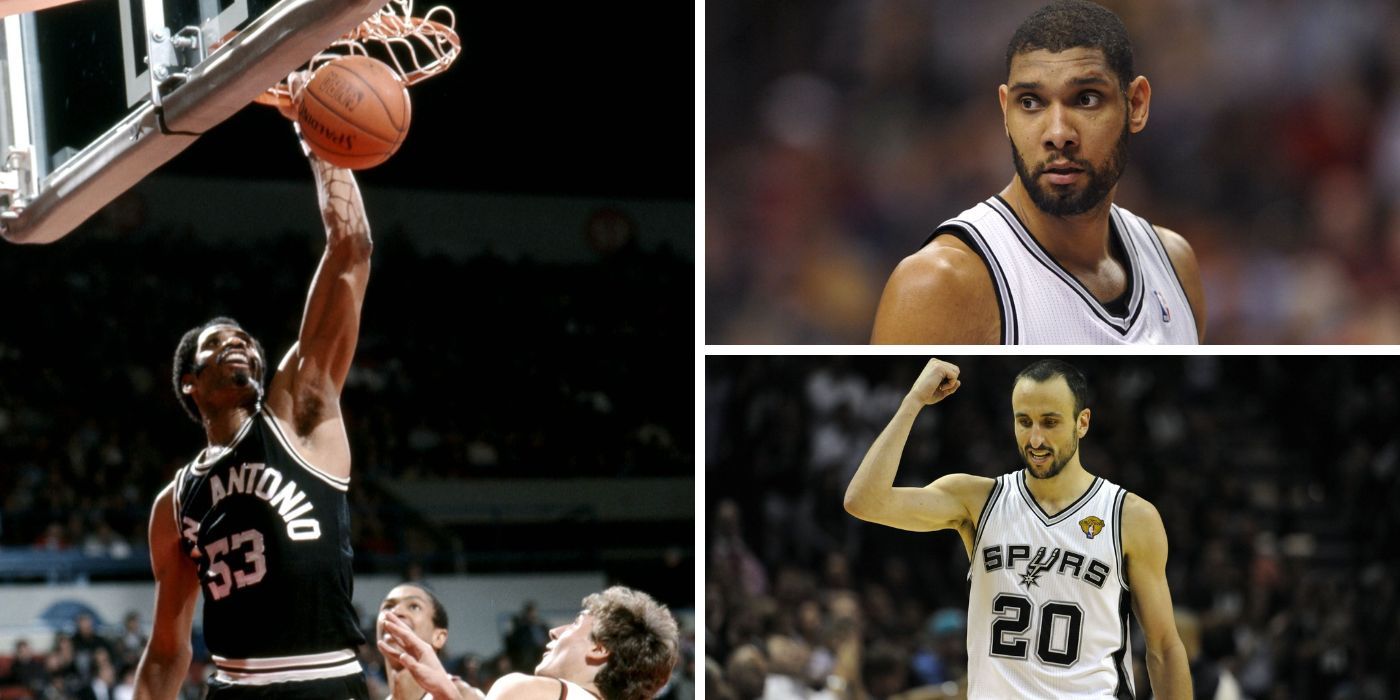
Duncan averaged 21.7 points, 11.4 rebounds and 2.5 blocks per game, and was named to the All-NBA First Team, and to the NBA All-Defensive First Team, while David Robinson averaged 15.8 points, 10.0 rebounds and 2.4 blocks per game. In addition, Sean Elliott provided the team with 11.2 points per game, and Elie and Avery Johnson both contributed 9.7 points per game each, while Johnson led the team with 7.4 assists per game. Duncan also finished in third place in Most Valuable Player voting behind Karl Malone and Alonzo Mourning, and Robinson finished in fourth place in Defensive Player of the Year voting, while Duncan finished tied in fifth place.
In the Western Conference First Round of the playoffs, the Spurs defeated the Minnesota Timberwolves three games to one. In the Western Conference Semi-finals, the Spurs' "Twin Towers" of Duncan and Robinson outplayed Shaquille O'Neal and Kobe Bryant as they swept the Los Angeles Lakers in four straight games. In the Western Conference Finals, the Spurs faced the Portland Trail Blazers. After taking Game 1 with an 80–76 win, the Spurs trailed by 17 points in Game 2. However, the Spurs made a fourth-quarter run that culminated with a game-winning three-pointer from Elliott, as they won 86–85. The Spurs went on to sweep the Trail Blazers in four straight games, becoming the first former American Basketball Association (ABA) team to play in the NBA Finals.
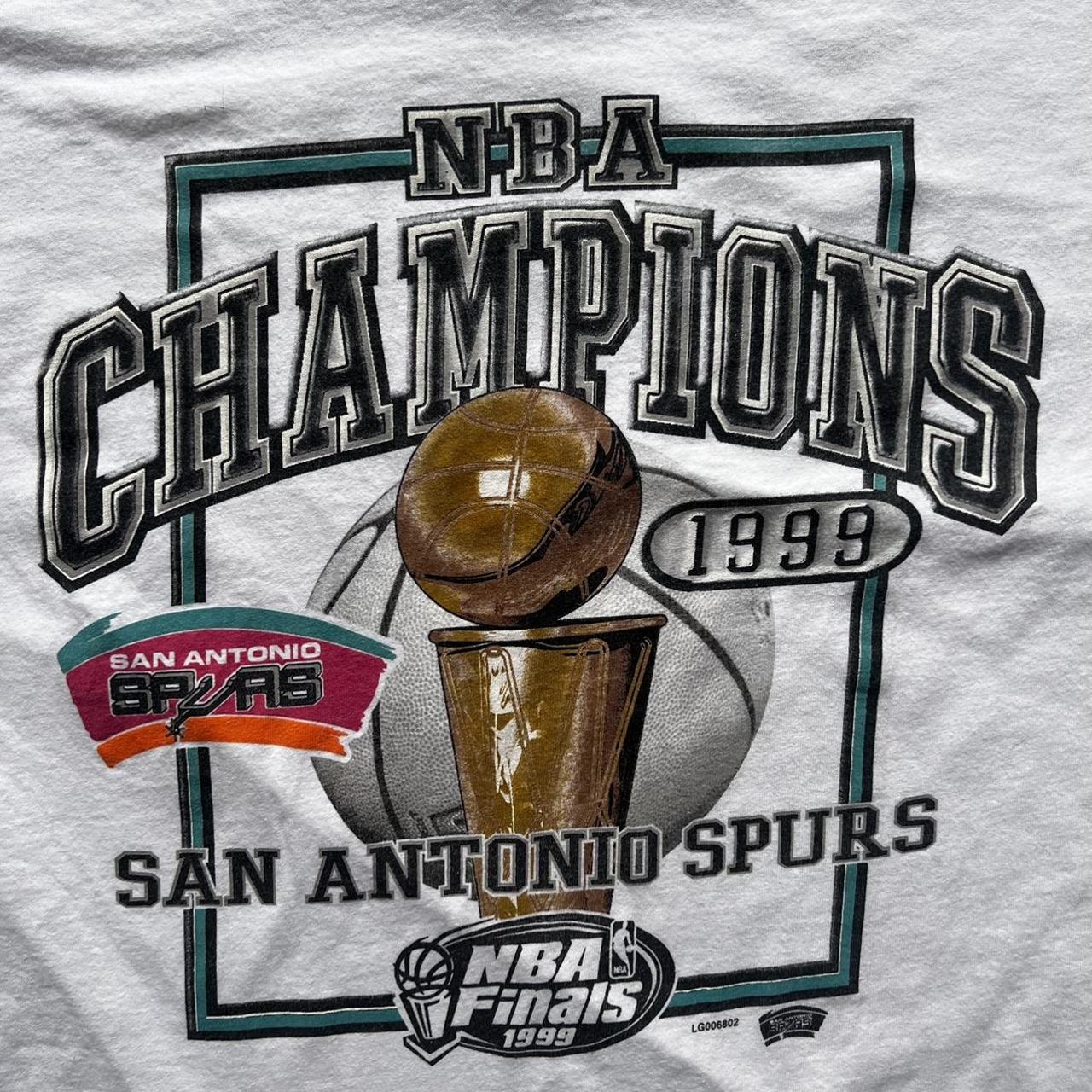
In the Finals, the Spurs defeated the eighth-seeded New York Knicks in five games. Johnson hit the title-winning shot with 47 seconds left to seal the Spurs' first title in franchise history. Duncan was named Finals MVP. Kerr, who previously won three straight championships with the Chicago Bulls, won his fourth consecutive title. Following the season, Will Perdue re-signed as a free agent with his former team, the Chicago Bulls.
In 2024, HoopsHype would list this Spurs squad as the team with the 24th easiest route to an NBA Finals championship, due to the opponents they faced in the first round, and the NBA Finals in particular.
Offseason
On June 24, 1998, the Spurs traded Carl Herrera and first-round draft pick Felipe Lopez to the Vancouver Grizzlies for guard Antonio Daniels. The team also signed free agents Mario Elie, Steve Kerr and Jerome Kersey during the offseason.
NBA draft
Roster
Regular season
Season standings
- z - clinched division title
- y - clinched division title
- x - clinched playoff spot
Record vs. opponents
Game log
Regular season
Playoffs
Player statistics
Regular season
Playoffs
NBA Finals
The 1999 NBA Finals saw some firsts for both the Spurs and the opposing New York Knicks.
The Spurs:
- Became the first former ABA team to play and win in an NBA Finals. (This feat would be duplicated by the Denver Nuggets in 2023.)
- Attracted record crowds for the two games at the Alamodome. Attendance was 39,514 for Game 1 and 39,554 for Game 2 (the largest crowd to see an NBA Finals game).
- Steve Kerr became the first non-Celtic to win four straight championships, as he won titles with the Bulls from 1996 to 1998.
The Knicks became the first 8th seed to ever play in an NBA Finals. (This feat would be duplicated by the Miami Heat in 2023.)
Summary
The following scoring summary is written in a line score format, except that the quarter numbers are replaced by game numbers.
With time running out in Game 5, and the 1999 championship on the line, the Spurs looked to Avery Johnson as he hit a long clutch 2 from the corner with 47 seconds to go, giving the Spurs a 1-point lead. It was considered one of the franchise's best moments since the first 26 years in San Antonio.
Schedule
- Game 1 - June 16, Wednesday @San Antonio, San Antonio 89, New York 77: San Antonio leads series 1-0
- Game 2 - June 18, Friday @San Antonio, San Antonio 80, New York 67: San Antonio leads series 2-0
- Game 3 - June 21, Monday @New York, New York 89, San Antonio 81: San Antonio leads series 2-1
- Game 4 - June 23, Wednesday @New York, San Antonio 96, New York 89: San Antonio leads series 3-1
- Game 5 - June 25, Friday @New York, San Antonio 78, New York 77: San Antonio wins series 4-1
The Finals were played using a 2-3-2 site format, where the first two and last two games are held at the team with home court advantage. The NBA, after experimenting in the early years, restored this original format for the Finals in 1985. So far, the other playoff series are still running on a 2-2-1-1-1 site format.
Award winners
- Tim Duncan, Forward, All-NBA First Team
- Tim Duncan, Forward, All-NBA Defensive First Team
- Tim Duncan, Forward, NBA Finals MVP
References
- San Antonio Spurs on Database Basketball
- San Antonio Spurs on Basketball Reference